◆All breakfasts, 11 dinners and 11 lunches (mostly box or picnic lunches)
◆Immersive itinerary with all transport (4x4 and minibus) and listed activities
◆Expert tour leader to enhance your adventure
◆Group arrival and departure transfers available
◆Request a single room if required (available for four nights only), purchase travel insurance and arrange any visas and vaccinations.
At a glance
Duration
16 days
Route
→
Countries
Tajikistan
Activity level
easy
Style
Multi-Country / Grand Tour
Group size
Ask
Flights
Not included
Solo travellers
Ask an agent
Day by day
Your journey through
Tajikistan
Showing Days 1-7
16-day itinerary
Day 1Arrive DushanbeBegin your adventure in Dushanbe, the capital and cultural heart of Tajikistan, laid along the Varzob River and framed by the foothills of the Hissar Range. Most international flights arrive either late tonight or in the very early hours of Day 2, so we recommend booking pre-tour hotel nights to ease into the trip. Want more time in Dushanbe? Secure pre-tour hotel nights through your sales representative.
Begin your adventure in Dushanbe, the capital and cultural heart of Tajikistan, laid along the Varzob River and framed by the foothills of the Hissar Range. Most international flights arrive either late tonight or in the very early hours of Day 2, so we recommend booking pre-tour hotel nights to ease into the trip. Want more time in Dushanbe? Secure pre-tour hotel nights through your sales representative.
Day 2Explore DushanbeSay hi to your leader and fellow travellers this morning, when we gather as a group to get to know each other and learn more about the adventures ahead. We leave the hotel around 10.30am and start exploring Dushanbe, the capital of Tajikistan. We start with an overview of Tajik history at the National Museum of Antiquities, where we see a reclining Buddha statue. Next, we visit Mehrgon Market where we can try local fruits and learn Tajik bargaining skills. We have lunch (not included) in a cafe within a training centre run by the NGO Chatr, which means umbrella. The centre provides free courses to women who have suffered abuse. Later in the afternoon, we walk beside the fountains of Rudaki Avenue and visit the Rudaki Monument, dedicated to the founder of Tajik-Persian literature. We also see the Ismail Somoni monument to the first emir of the Tajik nation. Next stop is the Gurminj Musuem of Pamiri Musical Instruments. We end the day with the choice of a cooking class or pottery demonstration. The cooking class sees us learn about plov, the rice and meat-based national dish.
Say hi to your leader and fellow travellers this morning, when we gather as a group to get to know each other and learn more about the adventures ahead. We leave the hotel around 10.30am and start exploring Dushanbe, the capital of Tajikistan. We start with an overview of Tajik history at the National Museum of Antiquities, where we see a reclining Buddha statue. Next, we visit Mehrgon Market where we can try local fruits and learn Tajik bargaining skills. We have lunch (not included) in a cafe within a training centre run by the NGO Chatr, which means umbrella. The centre provides free courses to women who have suffered abuse. Later in the afternoon, we walk beside the fountains of Rudaki Avenue and visit the Rudaki Monument, dedicated to the founder of Tajik-Persian literature. We also see the Ismail Somoni monument to the first emir of the Tajik nation. Next stop is the Gurminj Musuem of Pamiri Musical Instruments. We end the day with the choice of a cooking class or pottery demonstration. The cooking class sees us learn about plov, the rice and meat-based national dish.
Day 3To Kulob and AnjirobWe drive south from Dushanbe passing through hilly landscapes and pastures to reach Norak Dam. We continue to Hulbuk Fortress and museum in Vose to learn more about the regional history. Following a stop for lunch (not included) in the city of Kulob, we visit the mausoleum of Mir Said Ali Hamadani, a poet from Iran who preached Islam in Central Asia. Our drive continues over the Shurobod Pass to Anjirob, where we stay overnight with a local family. We cover around 150mi (240km) today on good roads, which takes about six hours with stops, with a maximum altitude of 2890 ft/880m. Daytime temperatures can be very high today.
We drive south from Dushanbe passing through hilly landscapes and pastures to reach Norak Dam. We continue to Hulbuk Fortress and museum in Vose to learn more about the regional history. Following a stop for lunch (not included) in the city of Kulob, we visit the mausoleum of Mir Said Ali Hamadani, a poet from Iran who preached Islam in Central Asia. Our drive continues over the Shurobod Pass to Anjirob, where we stay overnight with a local family. We cover around 150mi (240km) today on good roads, which takes about six hours with stops, with a maximum altitude of 2890 ft/880m. Daytime temperatures can be very high today.
Day 4Markhor goats and a Zoroastrian water templeFollowing a very early start, we drive to into the hills to view markhor goats, the largest member of the goat family, best known for their twisting horns. This animal-watching adventure can take about three hours including the driving. We do this very early while temperatures are cooler as chances of seeing the goats are better before the heat of the day sends them to shelter behind cool rocks. This can mean leaving our homestay at approximately 4 am (it is possible to remain at the homestay if you prefer). The goats are usually seen through binoculars or a telescope. As we continue our journey, the road squeezes through the gorge of the Panj River into the western Pamirs. The Panj forms the border with Afghanistan, which we follow for the next few days, allowing us to peer into Afghanistan along the way. On arrival in Kalai Khumb (altitude 1,270m), we walk in town or visit the Karon archaeological site, which is thought to be the last-surviving Zoroastrian water temple in Central Asia and has only been excavated relatively recently. There are fantastic mountain views from the site. There are about three hours of driving today (75mi/120km) mostly on good roads, with a maximum altitude of 1,270m.
Following a very early start, we drive to into the hills to view markhor goats, the largest member of the goat family, best known for their twisting horns. This animal-watching adventure can take about three hours including the driving. We do this very early while temperatures are cooler as chances of seeing the goats are better before the heat of the day sends them to shelter behind cool rocks. This can mean leaving our homestay at approximately 4 am (it is possible to remain at the homestay if you prefer). The goats are usually seen through binoculars or a telescope. As we continue our journey, the road squeezes through the gorge of the Panj River into the western Pamirs. The Panj forms the border with Afghanistan, which we follow for the next few days, allowing us to peer into Afghanistan along the way. On arrival in Kalai Khumb (altitude 1,270m), we walk in town or visit the Karon archaeological site, which is thought to be the last-surviving Zoroastrian water temple in Central Asia and has only been excavated relatively recently. There are fantastic mountain views from the site. There are about three hours of driving today (75mi/120km) mostly on good roads, with a maximum altitude of 1,270m.
Day 5Along the Pamir Highway to KhorogIf we didn't visit Karon yesterday, we do so this morning. We continue our drive along the Panj River, tracing the border, stopping for a box lunch along the way. Early afternoon, we reach Khorog, the capital of the mountainous Badakhshan region. At an altitude of around 6,800ft (2,100m), it sits in a narrow valley where the Shakhdara and Ghund rivers flow into the Panj. While small, the town is an important cultural centre with two universities and a theatre. We explore Khorog, walking through Chorbogh park. We drive for around seven hours (160mi/260km) today including stops, mostly on a poor road which is undergoing construction work in places which can sometimes delay our journey. Maximum altitude of 6,840ft (2,085m).
If we didn't visit Karon yesterday, we do so this morning. We continue our drive along the Panj River, tracing the border, stopping for a box lunch along the way. Early afternoon, we reach Khorog, the capital of the mountainous Badakhshan region. At an altitude of around 6,800ft (2,100m), it sits in a narrow valley where the Shakhdara and Ghund rivers flow into the Panj. While small, the town is an important cultural centre with two universities and a theatre. We explore Khorog, walking through Chorbogh park. We drive for around seven hours (160mi/260km) today including stops, mostly on a poor road which is undergoing construction work in places which can sometimes delay our journey. Maximum altitude of 6,840ft (2,085m).
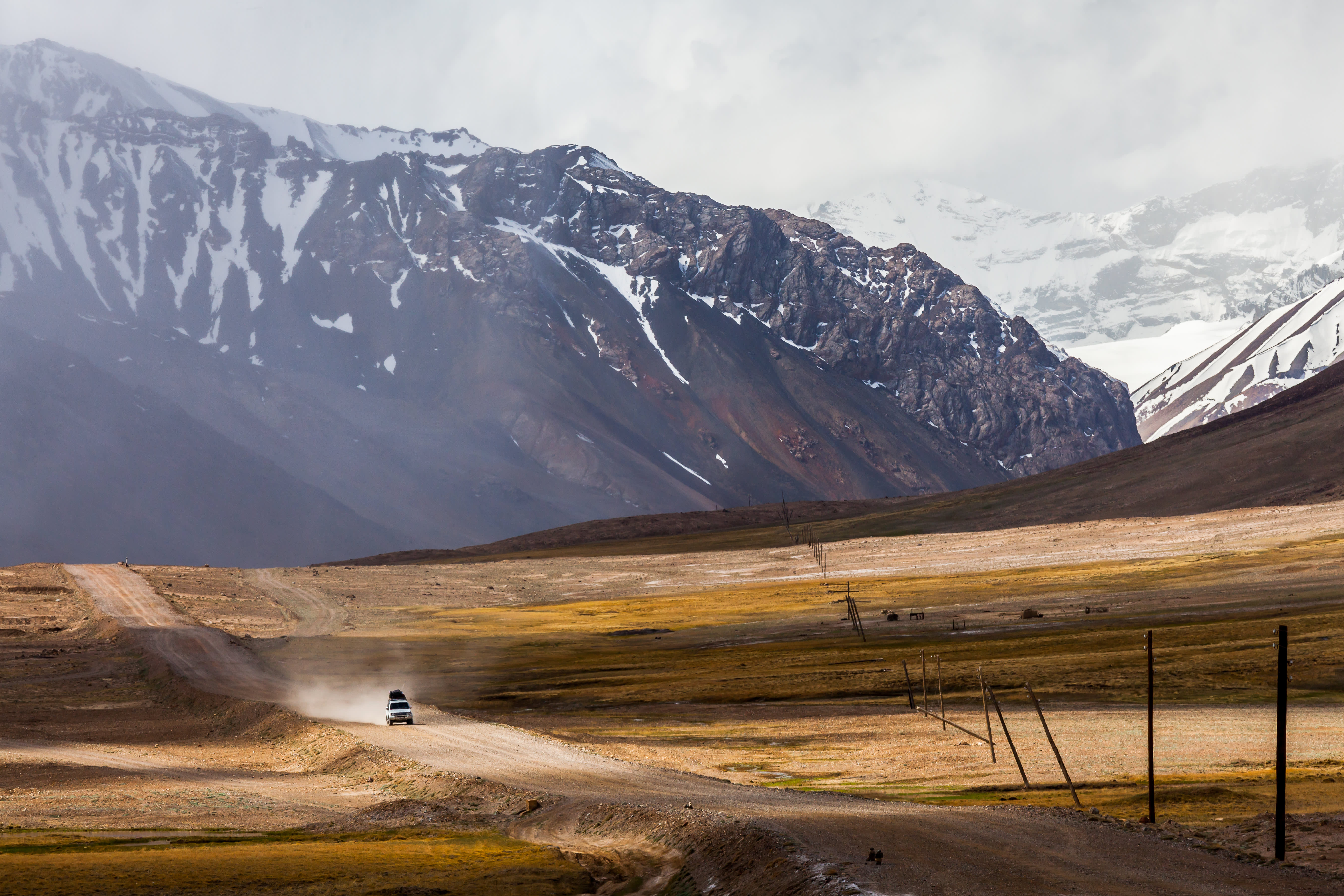
Day 6Into the Wakhan ValleyThis morning, we visit Khorog bazaar. Here, we can purchase traditional goods, including juraby (woollen socks) and toki (colourful embroidered skullcaps). We also visit Khorog botanical gardens, high above the city. From Khorog, the Pamir Highway heads east. However, we'll head south, continuing along the Panj River and the Afghan border. We stop at Garm Chashma, a small town home to sacred, sulphurous hot springs. Impressive white-yellow deposits are formed where the water flows out of the earth and cools. We continue to Ishkashim, where the valley widens and the waters of the Panj calm. This is the start of the Wakhan Valley, a legendary area in the Silk Road age. Always remaining in Tajikistan, we follow a route along the edge of the Wakhan Corridor, which once acted as a buffer between the Russian and British empires during the Great Game. This sliver of Afghanistan separates Tajikistan from Pakistan to the south. To the east lies the Xinjiang province of China. The Wakhan is home to mountain fortresses and numerous other intriguing sites. To the north are the Pamirs, to the south are the mountains of the Hindu Kush and Karakoram. We have a picnic lunch in Namadgut and visit Qah-Qaha fortress and Shohi Mardon shrine. We have views to Karl Marx Peak (22,057ft/6,723m) and Engels Peak (21,348ft/6,507m). In the evening, we reach Yamg and spend the night in a chid, a traditional Pamiri home. Following dinner, we have a demonstration of local Pamiri dances. We drive for around six hours today (155mi/250km) including stops, with a maximum altitude of 2,750m. The condition of the road today is generally reasonable.
Into the Wakhan Valley
This morning, we visit Khorog bazaar. Here, we can purchase traditional goods, including juraby (woollen socks) and toki (colourful embroidered skullcaps). We also visit Khorog botanical gardens, high above the city. From Khorog, the Pamir Highway heads east. However, we'll head south, continuing along the Panj River and the Afghan border. We stop at Garm Chashma, a small town home to sacred, sulphurous hot springs. Impressive white-yellow deposits are formed where the water flows out of the earth and cools. We continue to Ishkashim, where the valley widens and the waters of the Panj calm. This is the start of the Wakhan Valley, a legendary area in the Silk Road age. Always remaining in Tajikistan, we follow a route along the edge of the Wakhan Corridor, which once acted as a buffer between the Russian and British empires during the Great Game. This sliver of Afghanistan separates Tajikistan from Pakistan to the south. To the east lies the Xinjiang province of China. The Wakhan is home to mountain fortresses and numerous other intriguing sites. To the north are the Pamirs, to the south are the mountains of the Hindu Kush and Karakoram. We have a picnic lunch in Namadgut and visit Qah-Qaha fortress and Shohi Mardon shrine. We have views to Karl Marx Peak (22,057ft/6,723m) and Engels Peak (21,348ft/6,507m). In the evening, we reach Yamg and spend the night in a chid, a traditional Pamiri home. Following dinner, we have a demonstration of local Pamiri dances. We drive for around six hours today (155mi/250km) including stops, with a maximum altitude of 2,750m. The condition of the road today is generally reasonable.
Day 7Exploring the Wakhan ValleyWe start the day with a visit to the lovingly decorated Muborakkadam Wakhoni musuem. Wakhoni was a Sufi educator, astronomer and musician. We see a stone solar calendar in Yamg. Next, we drive back to Yamchun to visit an impressive mountain fortress giving us views across the Wakhan and its fertile gardens, fields and villages. We visit the thermal baths of Bibi Fatima and marvel at a Buddhist stupa in Vrang, plus observe numerous cliff caves once inhabited by Buddhist monks. In Zong, we can climb the imposing ruins of Abreshim Qala fortress and gain views of the Pamir and Wakhan rivers merging to form the Panj, which we've followed over much of the previous days. We spend the night in Langar. We drive for around four hours today with stops, covering around 40mi (70km) with a maximum altitude of 2,880m. Road conditions today are generally reasonable.
Exploring the Wakhan Valley
We start the day with a visit to the lovingly decorated Muborakkadam Wakhoni musuem. Wakhoni was a Sufi educator, astronomer and musician. We see a stone solar calendar in Yamg. Next, we drive back to Yamchun to visit an impressive mountain fortress giving us views across the Wakhan and its fertile gardens, fields and villages. We visit the thermal baths of Bibi Fatima and marvel at a Buddhist stupa in Vrang, plus observe numerous cliff caves once inhabited by Buddhist monks. In Zong, we can climb the imposing ruins of Abreshim Qala fortress and gain views of the Pamir and Wakhan rivers merging to form the Panj, which we've followed over much of the previous days. We spend the night in Langar. We drive for around four hours today with stops, covering around 40mi (70km) with a maximum altitude of 2,880m. Road conditions today are generally reasonable.
1 / 3
Where you'll stay & how you'll travel
Accommodation
Overview
Itinerary
Dates & Prices
Accommodation
Essential Info
Reviews
All accommodation: 4 Classic nights (hotels), 11 Simple nights (homestays and guesthouses)
All breakfasts, 11 dinners and 11 lunches (mostly box or picnic lunches)
Immersive itinerary with all transport (4x4 and minibus) and listed activities
Expert tour leader to enhance your adventure
Group arrival and departure transfers available
Request a single room if required (available for four nights only), purchase travel insurance and arrange any visas and vaccinations.
Meals
Overview
Itinerary
Dates & Prices
Accommodation
Essential Info
Reviews
All accommodation: 4 Classic nights (hotels), 11 Simple nights (homestays and guesthouses)
All breakfasts, 11 dinners and 11 lunches (mostly box or picnic lunches)
Immersive itinerary with all transport (4x4 and minibus) and listed activities
Expert tour leader to enhance your adventure
Group arrival and departure transfers available
Request a single room if required (available for four nights only), purchase travel insurance and arrange any visas and vaccinations.
Transport
Overview
Itinerary
Dates & Prices
Accommodation
Essential Info
Reviews
All accommodation: 4 Classic nights (hotels), 11 Simple nights (homestays and guesthouses)
All breakfasts, 11 dinners and 11 lunches (mostly box or picnic lunches)
Immersive itinerary with all transport (4x4 and minibus) and listed activities
Expert tour leader to enhance your adventure
Group arrival and departure transfers available
Request a single room if required (available for four nights only), purchase travel insurance and arrange any visas and vaccinations.
TripFinder compares the available catalog facts and can help with the booking. You travel under the operator's terms; final price and availability are confirmed before purchase.

 Into the Wakhan Valley